
Is There a Free Website That Can Do Competitor Analysis? Honest Comparison
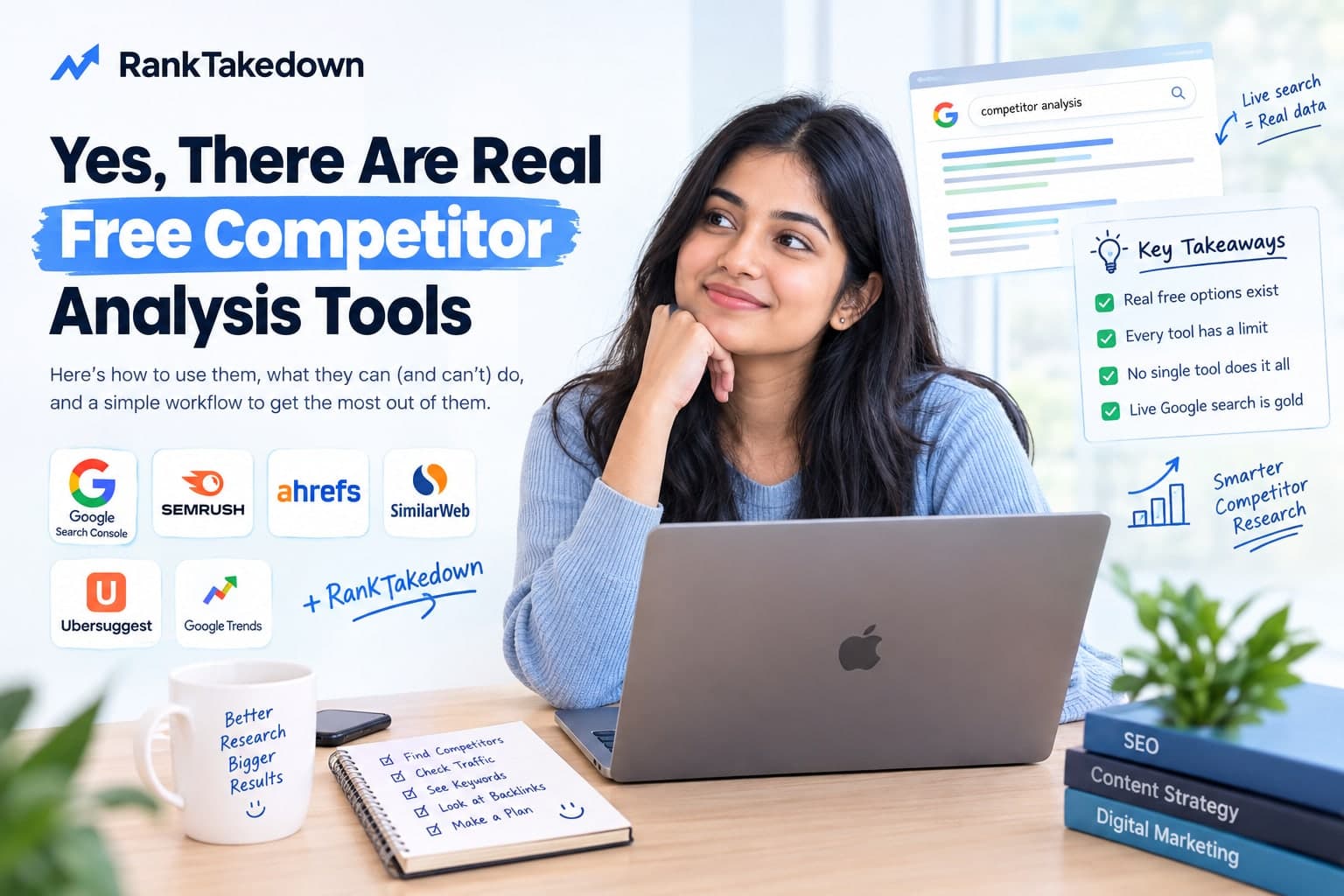
Yes, there are real free competitor analysis tools — the honest caveat is that "free" almost always means "free with a hard limit," not "free and unlimited." Knowing exactly where each tool's limit sits is what actually determines whether it's useful for your situation.
Table of Contents
Key Takeaways
- Real free options exist — Google's own tools, plus free tiers from Semrush, Similarweb, Ahrefs, and Ubersuggest.
- Every free tier caps something specific: searches per day, historical data depth, or export access.
- No single free tool covers organic keywords, backlinks, and traffic estimation all at once — you'll combine 2-3.
- A live Google search audit (checking who's actually ranking right now) costs nothing and beats a stale database lookup for finding real, current targets.
What "Free" Actually Means Here
Competitor analysis tools make money from the deep, historical, exportable version of their data — that's the paid tier. The free tier exists as a taste: enough real data to prove the tool works, capped hard enough that serious, repeated use pushes you toward upgrading. That's not a criticism, it's just how the business model works, and understanding it tells you what to expect: a handful of lookups a day, not unlimited research.
The Best Free Tools You Can Use Today
- 1RankTakedown: runs a live Google SERP scan for your site/niche and scores each currently-ranking competitor page on exactly how beatable it is — word count gap, freshness, structure — instead of a generic keyword list. New accounts get 10 free credits to run real audits before paying anything.
- 2Google Search Console + a live search: free, unlimited, and the only source that shows exactly who's ranking for your target keywords right now — not a database snapshot from weeks ago.
- 3Semrush's free tools: useful for a quick check of which domains compete with you for the same organic keywords, with shared-keyword and estimated-traffic data — deeper historical/PPC data sits behind the paywall.
- 4Similarweb's free website checker: estimated visits, engagement signals, and traffic-source breakdown for a competitor's domain — good for a fast "how big are they, really" gut check.
- 5Ahrefs free account: a limited number of backlink searches per month — enough for an occasional spot-check of a competitor's link profile, not for ongoing monitoring.
- 6Ubersuggest: beginner-friendly ranking-keyword and content-gap data, with a daily search cap on the free tier.
- 7Google Trends: completely free, no cap — best for comparing relative interest over time between your brand and a competitor's, not for keyword-level detail.
Side-by-Side Comparison
| Tool | Best Free Use | Where the Free Tier Stops |
|---|---|---|
| RankTakedown | Scoring exactly which ranking competitor pages are realistically beatable, from live data | 10 free credits on signup, then paid plans for continued use |
| Google Search + Search Console | Seeing who's actually ranking right now, for real | No competitor backlink or traffic-estimate data, no beatability scoring |
| Semrush (free) | Shared organic keywords between you and a rival | Historical trends, PPC data, deep exports |
| Similarweb (free) | Rough traffic size and traffic-source mix | Exact numbers, long history, page-level detail |
| Ahrefs (free account) | Occasional backlink spot-checks | Limited searches per month, no ongoing tracking |
| Ubersuggest | Ranking keywords and content-gap ideas | Daily search cap |
| Google Trends | Relative interest over time | No keyword-level or page-level detail |
Most of these tools answer "who's out there" — RankTakedown is built to answer the next, more useful question: "which of them can I actually beat." If you only try one tool from this list, that's the gap worth checking first — 10 free credits is enough to run a real audit on your own site before deciding.
What Free Tools Can't Do
What They're Genuinely Good For
A fast first read on a competitor you've never researched before.
Spot-checking a specific claim (traffic size, top keyword) without a subscription.
Validating whether a deeper, paid tool is even worth it for your situation.
Where They Fall Short
Ongoing monitoring — daily/monthly caps make ongoing tracking impractical.
Exporting data for a team or a report, which most free tiers block.
Full historical trend data, which is almost universally a paid feature.
Free vs. Paid: A Practical Line to Draw
There's no universal answer for when to start paying, but a useful test is frequency, not budget: if you're hitting a free tier's daily or monthly cap more than once a week, you're already paying for the free version in time — repeated waiting, workarounds, and re-checking things you couldn't finish in one session. That's usually the signal to upgrade one specific tool, not switch to a paid stack wholesale.
A second useful test is whether the thing you need is a one-time answer or an ongoing one. "How does this one competitor's pricing compare to mine right now" is a one-time question a free tool answers fine. "Alert me whenever a competitor publishes new content or changes their pricing" is an ongoing monitoring need, and free tiers are almost never built for that — it's the single most common reason teams eventually pay.
A Simple Free Workflow, Start to Finish
Rather than opening six tabs and hoping something useful turns up, run these free tools in a deliberate order:
- Start with a real audit, not a keyword list. Run your site/niche through a live SERP scan to see which competitor pages are currently ranking and how beatable each one actually is — this gives you named, current targets instead of an abstract "who are my competitors" guess.
- Sanity-check size with Similarweb's free checker. For each named target, get a rough read on their traffic and where it's coming from, so you're not spending a week on a competitor who turns out to be a minor player.
- Pull shared keywords from Semrush's free tools. This shows you exactly where your organic visibility overlaps with theirs — the intersection is where a head-to-head comparison is most useful.
- Spot-check backlinks with Ahrefs' free account, saving your limited monthly searches for the 2-3 competitors that survived the first three steps.
- Write it all down as you go. Since none of these free tiers export cleanly, a running doc is the only record you'll keep once each day's allowance resets.
How to Get the Most Out of Free Tools
- Spread lookups across tools instead of one: since each free tier caps daily/monthly usage, rotating between 2-3 tools gets you further than hammering one.
- Start with a live search, not a database: checking who's actually ranking for your target keyword right now, via a real search, is free, instant, and immune to the stale-data problem every paid database has between crawls.
- Write down what you find as you go: free tiers rarely let you export, so a running doc is the only record you'll have once the day's search allowance resets.
- Use free tools to triage, paid tools to go deep: a sensible workflow is free-tier research to identify 2-3 real targets, then a single paid lookup (or a tool with a real trial) only on those finalists.
Frequently Asked Questions
Is there a genuinely free website for competitor analysis?
Yes — Google Search/Search Console cost nothing and have no cap, and Semrush, Similarweb, Ahrefs, and Ubersuggest all offer real (if capped) free tiers.
What's the catch with free competitor analysis tools?
Nearly every free tier caps something — searches per day, historical data depth, or exports — so they work best for occasional spot-checks, not ongoing monitoring.
Which free tool is best for checking backlinks?
Ahrefs' free account allows a limited number of backlink searches per month — enough for an occasional check, not continuous tracking.
Which free tool is best for finding who's actually ranking right now?
A live Google search, or Search Console for your own site — both reflect the current live SERP rather than a cached database snapshot.
Do I need a paid tool eventually?
If you need ongoing monitoring, exportable reports, or deep historical trend data, yes — free tiers are built for occasional lookups, not continuous competitive tracking.
Can I do competitor analysis with no tools at all, just Google?
Yes, to a real extent — searching your target keywords directly and reading the top-ranking pages by hand shows you exactly who you're up against and what they've published. It doesn't give you traffic estimates or backlink data, but for a first pass on a new niche, a manual search is honestly underrated.
How many free tools should I actually use at once?
Two to three is usually the practical ceiling — enough to cross-check a claim (like traffic size) without spending more time managing tabs and daily limits than doing the actual analysis.
Want to know which pages you can actually outrank?
Run a live Google SERP audit and get a prioritized hitlist of beatable competitor pages — 10 free credits, no card required.
Try RankTakedown FreeRelated reading
Is There a Free Tool to Research Competitor Keywords? (Yes — Here's the Full List for 2026)
Yes — see every free tool for competitor keyword research in 2026, plus a workflow to find beatable competitor pages before you write.
How to Analyze Your Competitors' Marketing Strategy
Stop guessing what works. Discover how to evaluate competitor content, analyze live SERPs, and pinpoint the exact search opportunities your business can win.
The 80/20 Rule in SEO: What It Actually Means and How to Apply It
A small share of your pages and keywords drive most of your organic traffic. Here's how to find that 20%, and what to actually do once you have.