
The 80/20 Rule in SEO: What It Actually Means and How to Apply It
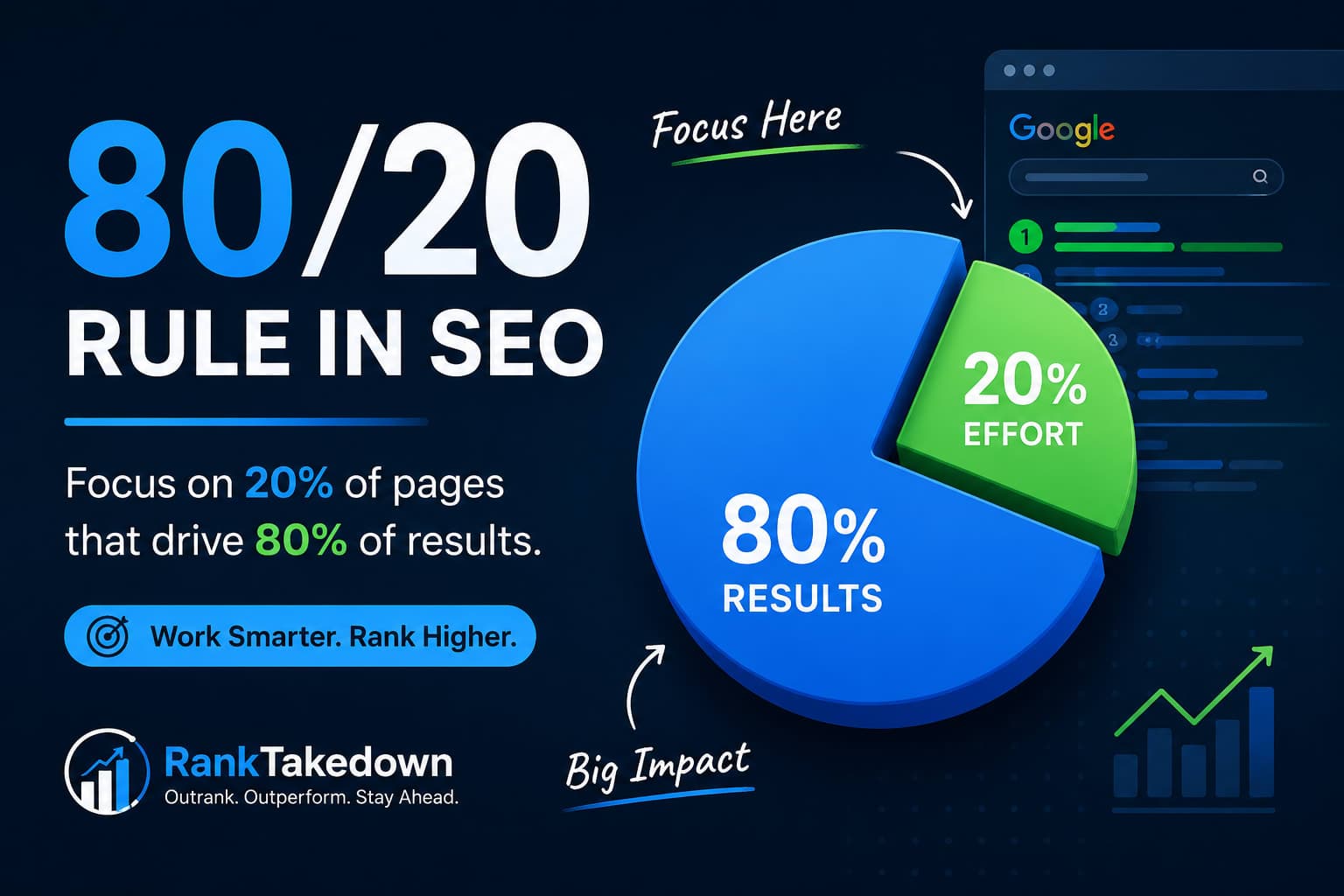
Most sites don't have an SEO effort problem — they have an SEO allocation problem. A handful of pages are quietly doing most of the work, while dozens of others sit untouched in the rankings, and nobody's checked which is which. That's the 80/20 rule, applied honestly instead of as a slogan.
Key Takeaways
The 80/20 rule (Pareto principle) in SEO means a small share of your pages or keywords typically drive most of your organic traffic and conversions.
It's a prioritization tool, not a literal 80%/20% split — the exact ratio varies by site.
Finding your 20% requires real analytics data (Search Console + GA), not guesswork.
It breaks down for new sites with no data yet, and for genuinely long-tail-dependent businesses.
What the 80/20 Rule Actually Means in SEO
The Pareto principle — 80% of outcomes from 20% of inputs — wasn't invented for SEO. It's a general observation about lopsided distributions, and search traffic happens to be one of the most lopsided distributions you'll find in a business. Pull the organic landing pages report for almost any established site and you'll usually see a small cluster of pages accounting for the majority of sessions, with a long, flat tail of pages getting a trickle each.
Applied to SEO, the rule isn't a prediction that you'll see exactly 80/20 — sometimes it's 90/10, sometimes 70/30. The number matters less than the shape: effort and results are not evenly distributed, so treating every page or every keyword as equally worth your time is a mistake.
Where It Shows Up in Real SEO Work
Four places this shows up constantly, once you go looking:
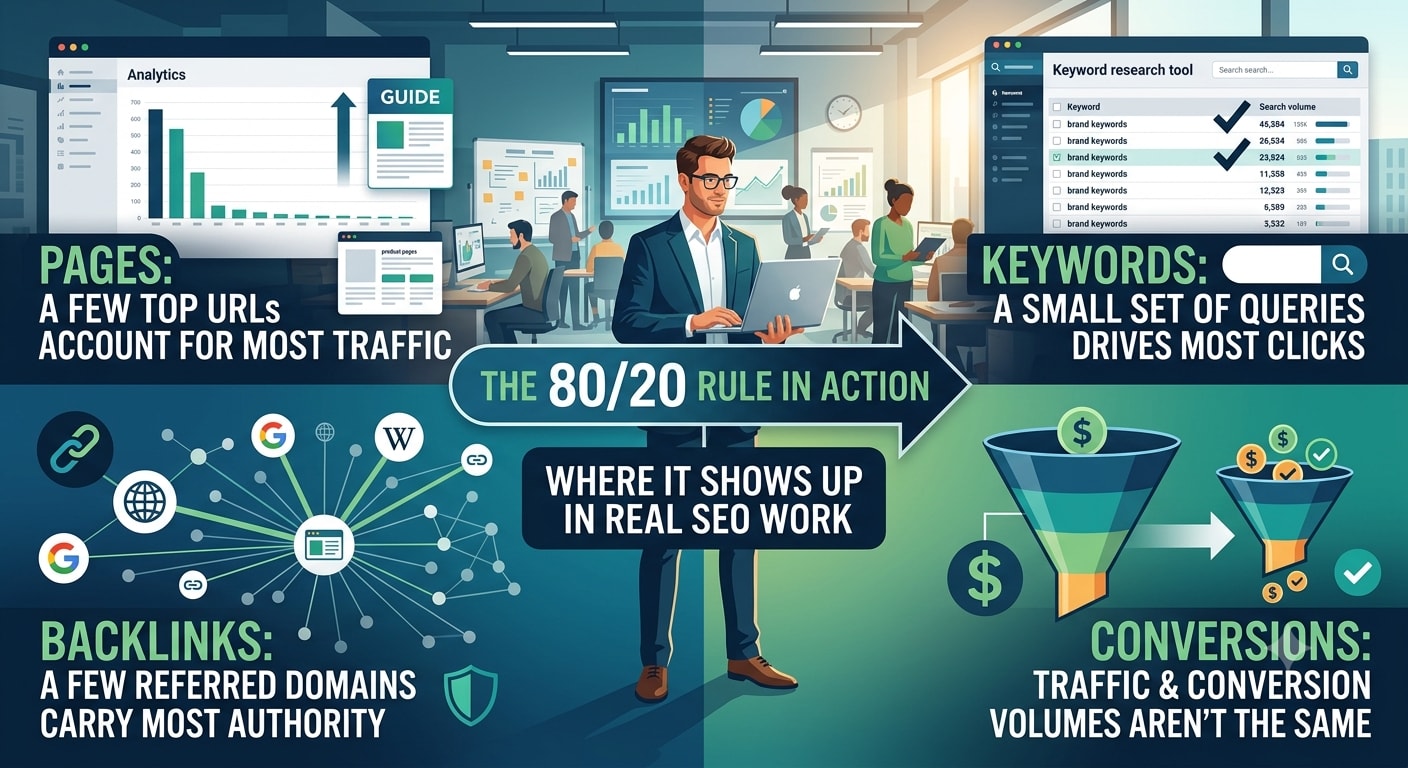
Pages: a small set of URLs — often top-of-funnel guides or a handful of product/category pages — account for most sessions.
Keywords: a small set of queries drives most clicks, even on sites ranking for thousands of terms.
Backlinks: a small number of referring domains carry most of the actual authority; the rest are low-value or borderline spam.
Conversions: traffic volume and conversion volume aren't the same distribution — a lower-traffic page can quietly out-convert your biggest earner.
How to Find Your 20%
This has to come from your own data — nobody can tell you which 20% matters for your site without looking at it. A practical pass:
Pull Search Console's Pages report for the last 12 months, sorted by clicks. Note how many pages it takes to reach 80% of total clicks — that number is your real ratio.
Cross-reference against conversions or revenue-per-page in analytics, not just traffic. A high-traffic page with near-zero conversion isn't part of your real 20%, even if it looks impressive in a traffic report.
Repeat the same exercise for keywords in the Queries report — the overlap between your top pages and top keywords usually reveals your actual core topic, even if you never wrote it down as one.
Applying It to Content
Once you know which pages are carrying the site, the 80/20 move is to protect and improve them before publishing anything new. Refresh dates, expand thin sections, fix internal links pointing away from them, and check they still match current search intent — a page that ranked well two years ago on outdated assumptions is losing ground quietly. Only after that should new content get the same investment, and even then, prioritize topics adjacent to what's already proven to convert rather than starting an unrelated new content pillar from zero.
The same logic applies to which new pages you go after. Not every ranking competitor page is worth the effort to outrank — some are backed by domain authority you can't realistically beat this quarter, while others are genuinely thin and beatable right now. This is exactly the highest-leverage 80/20 move for new content: instead of publishing broadly and hoping, RankTakedown scores each currently-ranking competitor page on how beatable it actually is, so you spend your writing time on the small set of targets most likely to move, not the whole list.
Applying It to Link Building
The same logic applies to backlinks. A hundred low-quality directory links rarely move the needle the way a handful of relevant, editorially-earned links do. If you're auditing an existing backlink profile, a Domain Rating or Domain Authority score sorted list will usually show the same lopsided pattern — most of your real authority concentrated in a small number of referring domains, with a long tail contributing almost nothing.
Applying It to Technical SEO
Technical SEO work has the same lopsided shape, and it's where the 80/20 rule gets ignored most often — teams run a 200-point technical audit and try to fix everything with equal urgency. In practice, a small number of technical issues account for most of the actual ranking impact: pages accidentally blocked from crawling, broken canonical tags on high-value pages, and Core Web Vitals failures on the templates your top-traffic pages actually use. A broken canonical on your highest-traffic template affects every page built from it; a missing alt tag on a low-traffic blog post affects almost nothing. Triage technical fixes the same way you triage content — by how much traffic or revenue sits behind the affected pages, not by how many issues a crawler flagged.
A Quick Worked Example
Take a mid-size blog with 400 published posts. Pull the 12-month Pages report and it's common to find that around 40-60 of those posts account for roughly 80% of total organic clicks — a ratio closer to 12-15/80 than a clean 20/80, which is normal; real data rarely lands on the exact number. The other 340+ posts are splitting the remaining fifth between them.
The 80/20 move here isn't to delete the long tail — some of it still converts, and deleting live URLs carries its own risk. It's to stop treating all 400 posts as equally worth a content team's time. The 40-60 top performers get refreshed first, get the best internal links, and get first priority when something breaks. Everything else gets checked periodically, but doesn't compete for the same attention.
When 80/20 Thinking Actually Hurts You
The Verdict
The 80/20 rule is a prioritization heuristic, not a law. It breaks down in two common cases: a brand-new site with no traffic history yet (there's no real 20% to find, since there's no data), and businesses that are genuinely long-tail by nature (some e-commerce catalogs and local-service sites earn most of their revenue from the aggregate long tail, not a concentrated top). If you're in either camp, don't force the framework — use it once you actually have enough data for the pattern to be real.
Frequently Asked Questions
What is the 80/20 rule in SEO?
It's the Pareto principle applied to organic search: a small share of your pages, keywords, or backlinks typically drives most of your traffic and conversions, so prioritizing that share tends to beat spreading effort evenly.
Is the ratio always exactly 80/20?
No — it's shorthand for a lopsided distribution, not a literal formula. The actual split varies by site and should be measured from your own Search Console/analytics data.
How do I find my top 20% of pages?
Sort Search Console's Pages report by clicks over the last 12 months and see how many pages it takes to reach roughly 80% of total clicks — that's your real number.
Does the 80/20 rule apply to backlinks too?
Yes — most sites see a small number of referring domains carrying most of their real link authority, with a long tail of low-value links contributing little.
When should I ignore the 80/20 rule?
On a brand-new site with little to no traffic history, or for a genuinely long-tail-dependent business where revenue comes from the aggregate tail rather than a concentrated top.
Is the 80/20 rule the same thing as the Pareto principle?
Yes — "80/20 rule" is the informal name people use for the Pareto principle once it's applied to a specific field like SEO, marketing, or business more broadly. Both describe the same underlying pattern: a minority of inputs producing a majority of outputs.
Should I redirect or delete the long-tail 80% of pages that aren't performing?
Not automatically. Some long-tail pages convert well despite low traffic, and deleting or redirecting a live URL carries its own risk if you're wrong about which bucket it's in. Check conversions and rankings before removing anything — the 80/20 rule is about where to focus first, not a mandate to prune everything outside the top tier.
Want to know which pages you can actually outrank?
Run a live Google SERP audit and get a prioritized hitlist of beatable competitor pages — 10 free credits, no card required.
Try RankTakedown FreeRelated reading
Is There a Free Tool to Research Competitor Keywords? (Yes — Here's the Full List for 2026)
Yes — see every free tool for competitor keyword research in 2026, plus a workflow to find beatable competitor pages before you write.
Is There a Free Website That Can Do Competitor Analysis? Honest Comparison
Yes — several. Here's what Semrush, Similarweb, Ahrefs' free tier, Ubersuggest, and Google's own free tools actually let you do for free, and where each one stops.
What Are the Four P's of Competitor Analysis? A Practical Guide
Product, Price, Place, and Promotion — the four P's break a competitor's entire strategy into parts you can actually compare and act on. Here's how to run the analysis properly.